May 17, 2008

Heighten Cardiovascular Health With Arjuna


tree.JPG

Heart disease is the number one killer of people in the US. So, one should to be concerned about what is needed to avoid being a victim of heart disease.

You might be wondering if there is a natural remedy that can serve as a preventative or relieve or reduce the symptoms of cardiovascular disease. Is there some natural remedy that can lower LDL, reduce angina, reduce congestive heart failure, ischemic heart disease, prevent and reduce the fat on your artery walls and lower high blood pressure?

Yes there is. It’s an herb called Arjuna. Arjuna comes from the Terminalia Arjuna tree, located throughout India.

In all of the clinical studies that have being performed it has shown significant improvement in patients tested. In tests for LDL cholesterol, it reduced LDL by 25% after 30 days of use with a dose of 500 mg per day.

People who suffered from angina attacks were put on Arjuna. During a 12 week period, these people had a 30% reduction in angina attacks.

Arjuna is also affordable. Most herbal remedies or supplements that can really do something for are expensive. Arjuna is quite a bit less at your health food store or when purchased through mail order.

Of course, before beginning any supplement, talk to your doctor first.


Tagged with:

May 13, 2008

What You Should Know About Pacemaker Surgery


 pacemaker2.jpg

A pacemaker is a small, battery operated medical device designed to electrically stimulate the heart in order to restore normal heart rhythm.

A pacemaker has two main parts: the pulse generator and pacing leads. The pulse generator is where the battery and electronic circuits are located. These circuits contain timers that regulate how often the pacemaker sends impulses to the heart.

Pacemaker surgery complications:
The most common complications of the pacemaker surgery are blood loss, infection, and lead dislodgement. However, the percentage of any of these complications occurring is very low.

The patient is given a single dose of antibiotics during the surgery to prevent infection. Antibiotics may also be given after the operation in selected cases.

If blood loss is excessive, which is very rare in pacemaker surgery, a blood transfusion may be necessary.

If a pacemaker lead moves from its proper position (highly unlikely), a second surgical procedure may be needed to reposition the displaced lead.

Restrictions for pacemaker patients:
Following the procedure, the patient will have certain restrictions for days or weeks. All patients with pacemakers are asked not to participate in contact sports. This restriction may be life-long.

In addition, patients will be asked to avoid interaction with certain electronic devices that may interfere with the pacemaker’s proper function.

Ask your doctor to give you all your post surgery instructions for your new pacemaker and be sure that you understand them.


Tagged with:

Learn About Truncus Arteriosus

trun.gif

The normal function of a heart includes two main blood vessels leaving the heart: the aorta carrying blood to the body and the pulmonary artery that delivers blood to each lung.

In patients with truncus arteriosus there is only one great blood vessel or trunk leaving the heart, which then feeds the blood vessels that go to the lungs and the body.

A patient with truncus arteriosus usually begins to have problems in the first week of life. Their oxygen levels are usually lower than normal.

Because of the excessive amount of blood flow to the lungs with this malformation, congestive heart failure develops very quickly. With an X-ray, the heart looks enlarged and the lungs look hazy.

Indications of congestive heart failure included rapid breathing, shortness of breath, wheezing, grunting or very noisy breathing, nasal flaring, and restlessness.

The liver may be enlarged; neck vein distention, poor feeding, and facial swelling are also seen.

While truncus arteriosus may be suspected, an echocardiogram will confirm the presence of the disorder.Initial treatment begins with stabilizing the patient. Medications to control congestive heart failure such as diuretics are often started.

The use of a feeding tube or intravenous feeding may be needed. Surgical correction is typically carried out in the first few weeks of life after the infant is stabilized and the surgical repair of truncus arteriosus requires the use of heart-lung bypass machine.

Currently over 90 percent of patients survive repair of truncus arteriosus. As the patient grows, they will need to be followed by their cardiologist.


Tagged with:

April 23, 2008

How Is Cardiac Exercise Testing Done

tread.jpg

Cardiac exercise testing is a valuable tool for gaining information about a patient’s heart and heart functioning, and their aerobic fitness.

Most cardiac tests are done with a person at rest, but most of the time people are active. Cardiac exercise testing can give information about how the heart responds to the extra demands of activity.

The graded cardiac exercise test collects information that is key for defining how a patient’s heart responds to various levels of exercise and assesses their level of fitness.

Based on the patient’s needs, age or ability, the exercise may be carried out on a treadmill, a stationary bike, or an arm ergometer.

On the treadmill, the cardiac exercise test consists of escalating stages that vary in speed and elevation. Tests performed on the bike or arm ergometer also progress through stages with resistance or work increasing with each stage.

The patient will have a blood pressure cuff on their arm. Blood pressure will be monitored at various levels of the exercise test.

To monitor the heart, an electrocardiogram (EKG) consisting of 10 electrodes will be attached to the patient’s chest.

A mouthpiece and nose clip may be used to measure the patient’s breathing and the volume of oxygen used during the test.

For more detailed information about the cardiac exercise test, ask your doctor.


Tagged with:

What Is Cardiac MRI And Who Needs One

mri2.JPG

MRI is the acronym for Magnetic Resonance Imaging. MRI uses a powerful magnet, radio waves and a computer to get pictures of any body part, including the heart. Cardiac MRI does not expose the patient to any radiation.

Who needs a cardiac MRI?

Cardiac MRIs are used for evaluation of patients with very specific heart conditions, usually those with previously operated congenital heart disease.

A cardiac MRI takes very clear pictures of the heart and blood vessels in the chest. Cardiac MRI is also able to provide detailed measurements of certain heart parameters unavailable by other means.

A Cardiac MRI test is performed by a specially trained MRI technologist, MRI Radiologist, an MRI Physicist, and a MRI Cardiologist. The test will be read by both a MRI Cardiologist and MRI radiologist.

Most patients do not require sedation. Some patients have claustrophobia and for these patients a small dose of Valium usually helps them to tolerate the scan.

Patients also must be able to follow instructions carefully, particularly in holding their breath for several seconds on command.

The only implanted devices absolutely not allowed in the MRI scanner are pacemakers and defibrillators, since the powerful MRI magnet may disrupt these devices. The magnet does not disrupt function of other metal devices, such as implanted articial heart valves. But any removable metal should be removed.

Check with your doctor for more info on Cardiac MRI.


Tagged with:

April 17, 2008

Do You Know What Cardiopulmonary Bypass Is

bypass.jpg

To fix most cardiac defects, the heart surgeon requires a bloodless, motionless field in which to work. To achieve this, the motion of the heart and lungs must be stopped.
For this to happen, there needs to be a means for blood to circulate through the body, delivering the necessary nutrients and oxygen to maintain life, while the heart and lungs are stopped. This is made possible through a process known as cardiopulmonary bypass (CPB).

Clear tubing (PVC) contains the patients’ blood as it is removed from the body. Large bore catheters (called cannula) are placed in the right side of the heart, allowing the desaturated blood from the body to enter the cardiopulmonary bypass unit. The PVC tubing runs through a mechanical pump that can be regulated to the proper cardiac output for a particular patient.

For example, a 5-year-old child has a much smaller cardiac output than an adult does; so the pump must run at a higher rate for an adult patient than a child. More tubing sends blood from the mechanical pump to a gas exchange device called an oxygenator, or artificial lung.

The oxygenator performs the same job as the lungs: oxygenation of the blood as well as removal of carbon dioxide. This re-oxygenated blood is then put back into the body through other tubing placed in the aorta.

Cardiopulmonary bypass permits the patients’ blood to bypass the heart and lungs, giving the desired bloodless, motionless operative environment while still supplying all the other organs of the body with a constant supply of oxygen and nutrient-rich blood.


Tagged with:

Information About Cardiac Catheterization

cardiac-catheterization.jpg

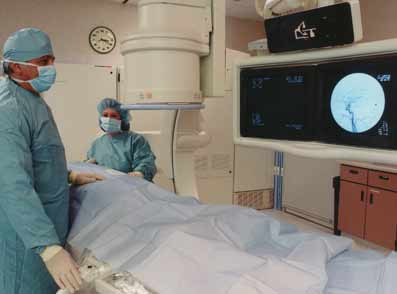
Cardiac catheterization is a procedure that punctures an artery or vein, usually located in the groin area, so that a small, long, flexible tube can be guided into the heart and major vessels around the heart.

The cardiac catheter is moved through the heart with the aid of an x-ray machine. This is usually done for diagnosing heart problems.

Interventional cardiac catheterization is a type of procedure where actual treatments can be performed by use of specialized catheters. These specialized catheters include balloon catheters that can open up narrowed valves or arteries and also catheters where devices can be deployed which can close extra vessels or certain “holes” in the heart.

Some intervention procedures are considered the first choice in treatment and are preferred over surgery. Some interventions are considered as a short-term solution until more definitive surgical procedures can be performed more safely. The types of cardiac catheterization performed are different for each patient. It is usually used where there are narrowed valves or arteries causing obstruction of blood flow.

Before the procedure the patient will need certain tests including a chest X-ray, an electrocardiogram (EKG), and some blood tests. The patient will be given some medication to make him sleepy before the procedure.After the catheterization, the patient will be taken to a recovery room where you will be observed for a couple of hours.

Depending on the type of intervention performed and how well the patient recovers, a longer period of observation or overnight admission to the cardiac unit may be required.

Ask your doctor for a more detailed explanation of this procedure.


Tagged with:

April 10, 2008

Do You Know What Myocarditis Is

card.jpg

Do you know what myocarditis is? If you answered no then you will find the answer to that question here.

Myocarditis is a medical condition where the muscular walls of the heart will become inflamed. The condition of myocarditis usually results in poor heart function.

There are many causes of the medical condition of myocarditis. These include infections, medications, chemicals, radiation, and certain diseases that cause inflammation in many different organs of the body. In most children, the medical condition of myocarditis is triggered by an infection, usually viral, involving the heart.

There are no known risk factors for developing myocarditis at the present time, but research is always going forward. The severity of disease seems to be dependent upon many factors such as the patients age, sex, and the genetic make-up of the patients immune system.

The treatment for myocarditis is ever evolving as the disease and it’s process is better understood. Many adult patients as well as patients that are children experience a complete recovery. However, some may develop serious heart failure and require chronic care by a cardiologist. There is no way to predict which patients will be palced in which category. Your cardiologist would best be able to give you the information for your particular situation.


Tagged with:

The Facts On Long Term Prognosis For Patients With Cardiomyopathy

 myop.gif

Cardiomyopathy is a serious disease. However, like most diseases, dilated cardiomyopathy happens with a range of severity and outcome.

Depending on the cause and the degree of irreversible damage to the heart muscle, about 1/3 of patients have persistent poor heart function, 1/3 improve but are left with some heart dysfunction, and 1/3 recover completely.

It is difficult to predict which category a patient will be in, therefore frequent cardiology follow-ups are extremely important. Patients who do have irreversible damage and persistent poor function may go on to need a heart transplant.

The exact number of patients with cardiomyopathy is unknown, as some patients will have no symptoms. The chance of premature death is estimated to be less than 1 %.

Risk factors for sudden death include episodes of fainting, family history of sudden death, marked heart thickening on echocardiogram and fast heart rhythms seen on monitoring.

Less than 5 % of patients will have later complications like enlargement of the left ventricle and decreased pumping function.

Restrictive cardiomyopathy accounts for only 5 % of patients with the disease. Only 45 to 50 % of patients with this type of cardiomyopathy are estimated to survive two years after the diagnosis. Some patients may also require heart or heart lung transplantation.

Of course each patient is different and only a trained physician can give you the correct data in your case.


Tagged with:

April 7, 2008

What Does It Mean When You’re Told Your Child Has An Ebstein’s Anomaly

newbornbaby.jpg

Ebstein’s anomaly is an abnormality in the tricuspid valve of the heart. These abnormalities cause the tricuspid valve to leak blood backwards into the right atrium when the right ventricle contracts and as a result, the right atrium becomes enlarged. If this is severe enough, congestive heart failure can result.

If pressure within the right atrium becomes overwhelming by the excessive backflow into it, the foramen ovale (which is normally present in the fetus and usually closes after birth) will remain open. The ovale allows unoxygenated (”blue”) blood to flow from the right atrium, bypassing the lungs and going directly to the body. This will result in lower oxygen levels in the blood.

Ebstein’s anomaly may range from mild, with little symptoms, to very severe. Many patients with milder Ebstein’s anomaly do not have symptoms and are diagnosed due to the presence of a heart murmur.

Some babies and children will have bluish discoloration to their lips and nail beds, due to the flow of blood from the right atrium to the left atrium. Children may tire more easily than other children or become short of breath, particularly during play. In adolescents and young adults, the sensation of palpitations, or fast heart rate, shortness of breath, and chest pain may be the first symptoms.

Severely affected babies are often critically ill at birth, with low oxygen saturations and heart failure requiring intensive care.

If your child is diagnosed with Ebstein’s anomaly, his pediatric cardiologist will discuss the treatment options appropriate for your child.


Tagged with: